כ"ו בכסלו תש"ע
Shamash 28
In follow-up to Through the Fires of Time (as posted on my blog Walking on Fire), there are four festivals of fire in stellar time. These are the Greater Sabbats, the High Holy Days, of traditional Celtic witchcraft.
The four Fire Festivals can occur anywhere between 29-59 days following the preceding solstice or equinox. Apices of feminine power in time, these sabbatot are Imbolc (between Yule and Ostara), Beltane (between Ostara and Litha), Lughnasadh (between Litha and Mabon) and Samhain (between Mabon and Yule).
The Lesser Sabbats of the solstices and equinoxes (namely - Mabon, Yule, Ostara and Litha) are yearly lunar power points linked to the earthly feminine biological cycle. While times of imbalance in the solar cycle, they are times of power for the feminine Earth.
The Lesser Sabbats ground us with the full feminine power of the Earth Mother. The Greater Sabbats, the cyclical Fire Festivals in the wheel of the pagan year, expands our consciousness into the otherworlds of the heavens, and fill us with the full power of Goddess.

Showing posts with label holy days. Show all posts
Showing posts with label holy days. Show all posts
Sunday, December 13, 2009


Sunday, September 20, 2009
Mother Of Manifest Blessing
 ג' בתשרי תש"ע
Blodlessing 4
In follow-up to earlier entries (Times of Judgment And Blessing and She Who Named Him Adam), complementing the Fehu rune and the three Hebrew triplets inscribed on my Rosh Hashanah-Mabon ritual candle as previously described, I also inscribed the mother of manifestation rune, namely, Uruz (pronounced ooo-rooze, like the 'oo' as in boo!). Uruz, with the phonetic values of 'u' and 'v', means drizzle, rain and horns of blessing. It is a force which patterns and formulates reality, natural order and tradition.
It rained here today.
Related entries:
Runes 1-3: Transmission of a Sacred Secret
Rune 4: The Wholiness Code
Rune 5: Mysteries of the Staircase
Rune 6: The Ship of Safe Passage
Rune 7: The Ætheling
Rune 8: Communication
Rune 9: The Nature Of My Work
Runes 10-11: Wyrd Shema
Rune 12: The View From My Room
Rune 13: Thurisaz On The Falling Man
Rune 14: Power To Do It
Rune 15: Wyrd Preparation
Saturday, September 12, 2009
Times Of Judgment And Blessing
 כ'ג באלול תשס״ט
Belz 24
This year, astrological Mabon in my location falls on September 22, a day which actually begins the evening before on September 21 according to the Celtic reckoning of time. At Mabon, the sun enters Libra, the zodiac sign represented by the Scales of Justice. Just as the Jewish observance of Rosh Hashanah (September 19-20 this year) is a time of judgment, so too is the Celtic observance of Mabon a time of judgment.
Unity and multiplicity in balanced harmony. My handpoured autumn equinox apple candle is thickly scented with traditional Mabon essences including apple blossom, cinnamon and other woodsy Mabon spices. Inscribed with the Fehu rune (a directing expansive force with which to facilitate projection and distribution of magical power person to person among one's soul family) and three Hebrew triplets (for prosperity, success, healing, health, and protection from the evil eye), my Mabon-Rosh Hashanah ritual candle will be anointed with cinnamon bark oil and sprinkled with basil.
May the scales of justice this wholy season find us balanced and fit for abundant blessing. So mote it be, אמן.
Sunday, August 10, 2008
Answering Tisha B'Av With Purpose
 ט' אב התשס"ח
Lughnasadh 10
Tisha B'Av
My handmade casting cloth looks like the one shown. Of very soft brown suede, the seams are hand sewn, the symbols and lines drawn with very dark dragon's blood ink, and the diagonals made using the straight edge of a broomstick.
The Unified Power Of The Divine Feminine Lifeforce
To craft my casting cloth, an 18" by 36" rectangle of material was folded into an 18" by 18" square. Eighteen is the gematria of חי (chai, a word symbolic of the Divine Lifeforce).
Thirty-six is the gematria of בכוח (be'koach, meaning "with energy, power, strength, ability, resource, authority"). Thus, the three measurements of 18 and the one measurment of 36 symbolize the unified three-fold (Maiden, Mother and Crone) Power of the Divine Feminine Lifeforce.
From Within The Land
The "square" turned inside out and completed of seams measured 16.75" by 17.5" for a total area of 293.125 square inches. The value of 293 is the gematria of בארץ (ba'aretz, meaning "within the Land").
Responds
The value of 125 is the gematria of ענה (anah, meaning "to answer, reply, respond"). From the root ענה is also derived a word for 'fasting' (see Vayikra 16:29).
To Answer With Purpose Upon My Casting Cloth
The square of the cloth symbolizes the Middle World (also see my recent shabbat entry Endless Legion From The Elementary Sea, where I dreamt I was sitting in the middle of the stairs). The Middle in Hebrew is ha'emtza (האמצע).
The inner square (Midhe) symbolizes Focus, and the powers of concentration, memory, recognition, and sensitivity to meaning.
The two superimposed X's (Cath) in the northern position symbolize friction or resistance (left pillar).
The western spiral curl (Fis) symbolizes enlightenment or expansion (right pillar).
The eastern grid (Blath) symbolizes harvest (ingathering).
The southern base to base triangles (Seis) symbolize balance (synthesis, the creation of purposeful meaning).
Saturday, April 19, 2008
Ceridwen Candle Dressing Oil
י'ד בניסן תשס"ח
Annwyn 15
Newest original recipe - Ceridwen Candle Dressing Oil
5 ml jajoba oil
salt-spoon full (approx. 1/8 tsp.) white willow, powdered
salt-spoon full (approx. 1/8 tsp.) white sandalwood, powdered
salt-spoon full (approx. 1/8 tsp.) blue vervain, crushed and ground
salt-spoon full (approx. 1/8 tsp.) hawthorne, powdered
pinch of calendula (marigold), small flower petals
6 coarse grains of Celtic Sea Salt
6 coarse grains of Dead Sea Salt from Israel
5 drops cedarwood oil
1 drop bergamot oil
Annwyn 15
Newest original recipe - Ceridwen Candle Dressing Oil
5 ml jajoba oil
salt-spoon full (approx. 1/8 tsp.) white willow, powdered
salt-spoon full (approx. 1/8 tsp.) white sandalwood, powdered
salt-spoon full (approx. 1/8 tsp.) blue vervain, crushed and ground
salt-spoon full (approx. 1/8 tsp.) hawthorne, powdered
pinch of calendula (marigold), small flower petals
6 coarse grains of Celtic Sea Salt
6 coarse grains of Dead Sea Salt from Israel
5 drops cedarwood oil
1 drop bergamot oil
Sunday, December 09, 2007
Secret Of Shalhevet
א' בטבת תשס"ח
Grael 2
1 part midsummer's sabbat balefire ash
1 part shabbat incense ash
1 part fine gold sparkles
1 part dark amber resin
1 pinch Dead Sea salt (Israel)
1 pinch Flower of the Ocean (hand-harvested Celtic sea salt)
Grael 2
1 part midsummer's sabbat balefire ash
1 part shabbat incense ash
1 part fine gold sparkles
1 part dark amber resin
1 pinch Dead Sea salt (Israel)
1 pinch Flower of the Ocean (hand-harvested Celtic sea salt)
Saturday, October 06, 2007
Crystal Caves
 כ'ד בתשרי תשס"ח
A witch chooses her unique healing crystal ball with the same tender loving care with which an etrog is chosen for sukkot. A healing crystal ball is not just a crystal ball. And a sukkot etrog is not just an etrog. Exquisite distinguishing love goes into choosing them. It's bashert.
Cover with a ritual cloth when not in use.
Saturday, August 11, 2007
Happiness Nut
 כ"ז באב תשס"ז
Gall nut pieces contain a heyuli for a long happy healthy life. A vessel of these will also grace my altar for the High Holy Days.
Altar Snowflake Obsidian Ball
 כ"ז באב תשס"ז
This 2" diameter (פת) snowflake obsidian "crystal" ball plays on the Rosh Hashanah candle inscription מי קרא פת and acts as a "sign" of the Divine (פת) "morsel" of sustenance and benevolence being brought down. It will grace my altar throughout the High Holy Days.
Rosh Hashanah Spell Candles
כ"ז באב תשס"ז
I will be using two 7" by 1.5" handcrafted pure beeswax candles for my Rosh Hashanah spellwork. The head of candle A and the base of the candle B will be ritually inscribed like this:

The base of candle A and the head of candle B will be ritually inscribed like this:

The side of the candle A will be ritually inscribed like this:

The side of the candle B will be ritually inscribed like this:

The inscription האה pertains to a feminine configuration of the Essential Divine Name containing the heyuli through which Divine Knowing extends into being.
The Ogham letters are my Celtic circle name Lleucu.
The paleo-Hebrew letters are my Hebrew name Liorah Chanah.
The modern Hebrew inscription מי קרא פת was revealed as I awoke from dreaming this Shabbat morning and directs Binah (of Chochmah on the path of mem, balancing Hod-Netzach) to summon and give form to a unified morsel of Divine Knowing.
The modern Hebrew inscription בינה קרה פתח creates the opening in reality to actualize the inscription above, and means "opening for Divine Understanding (of Divine Knowing) to happen" throughout Malchut.
The 3- and 4-shins represent Divine Matriarchal Wisdom and Understanding.
The spiral triskelion represents the feminine cauldron of Divine Knowing and Wholeness.
The shalshelet trope represents Da'at Torah, reception and transmission of Torah (mekubal/mashpia function), it's mysteries and mesorah.
Each candle will be dressed and handrolled with a mixture of Witch's Brew oil and Consecration incense blend.
I will be using two 7" by 1.5" handcrafted pure beeswax candles for my Rosh Hashanah spellwork. The head of candle A and the base of the candle B will be ritually inscribed like this:
The base of candle A and the head of candle B will be ritually inscribed like this:
The side of the candle A will be ritually inscribed like this:
The side of the candle B will be ritually inscribed like this:
The inscription האה pertains to a feminine configuration of the Essential Divine Name containing the heyuli through which Divine Knowing extends into being.
The Ogham letters are my Celtic circle name Lleucu.
The paleo-Hebrew letters are my Hebrew name Liorah Chanah.
The modern Hebrew inscription מי קרא פת was revealed as I awoke from dreaming this Shabbat morning and directs Binah (of Chochmah on the path of mem, balancing Hod-Netzach) to summon and give form to a unified morsel of Divine Knowing.
The modern Hebrew inscription בינה קרה פתח creates the opening in reality to actualize the inscription above, and means "opening for Divine Understanding (of Divine Knowing) to happen" throughout Malchut.
The 3- and 4-shins represent Divine Matriarchal Wisdom and Understanding.
The spiral triskelion represents the feminine cauldron of Divine Knowing and Wholeness.
The shalshelet trope represents Da'at Torah, reception and transmission of Torah (mekubal/mashpia function), it's mysteries and mesorah.
Each candle will be dressed and handrolled with a mixture of Witch's Brew oil and Consecration incense blend.
Wednesday, May 02, 2007
Astronomical Beltane
י"ד באייר תשס"ז
Henceforth, I will observe [1] a witch's Fire Festivals (cross-quarter points), equinoxes and solstices according to their actual astronomical correspondences.
For example, while Beltane (the Fire Festival marking the cross-quarter point between the vernal equinox and the summer solstice) is generally observed October 30/May 1, the actual astronomical midpoint between the vernal equinox and summer solstice is Saturday, May 5 at 4:08 pm in my time zone.
Consequently, I am resetting Beltane observance to May 5 this year and will observe the Sabbat a second time in parallel with Shabbat.
Footnote:
[1] ritually as an individual; although as a witch within the greater community of witches, I will still mark it at the traditional time
Henceforth, I will observe [1] a witch's Fire Festivals (cross-quarter points), equinoxes and solstices according to their actual astronomical correspondences.
For example, while Beltane (the Fire Festival marking the cross-quarter point between the vernal equinox and the summer solstice) is generally observed October 30/May 1, the actual astronomical midpoint between the vernal equinox and summer solstice is Saturday, May 5 at 4:08 pm in my time zone.
Consequently, I am resetting Beltane observance to May 5 this year and will observe the Sabbat a second time in parallel with Shabbat.
Footnote:
[1] ritually as an individual; although as a witch within the greater community of witches, I will still mark it at the traditional time
Wednesday, February 28, 2007
Incense Offering Ritual Procedure
י' באדר תשס"ז
Here is the ritual procedure I will be using to light the incense for my reversal and protection spell. The actions are based upon the Kohen Gadol's Yom Kippur avodah in the Kodesh Hakodoshim (Holy of Holies).
1. The censer rests on the upper left corner of the altar. Coal is lit with left hand during step 7 of the reversal procedure.
2. With left hand, place a chunk of kabbalistic name incense onto consecrated ritual spoon held with right hand.
3. Stick the handle of the ritual spoon under right arm.
4. Cup hands.
5. Bend over and allow contents of spoon to fall into cupped hands.
6. Pour incense from cupped hands onto burning coal in censer.
7. Say: May the words of my mouth, the meditations of my heart, and the actions of my hands be worthy and acceptable.
Here is the ritual procedure I will be using to light the incense for my reversal and protection spell. The actions are based upon the Kohen Gadol's Yom Kippur avodah in the Kodesh Hakodoshim (Holy of Holies).
1. The censer rests on the upper left corner of the altar. Coal is lit with left hand during step 7 of the reversal procedure.
2. With left hand, place a chunk of kabbalistic name incense onto consecrated ritual spoon held with right hand.
3. Stick the handle of the ritual spoon under right arm.
4. Cup hands.
5. Bend over and allow contents of spoon to fall into cupped hands.
6. Pour incense from cupped hands onto burning coal in censer.
7. Say: May the words of my mouth, the meditations of my heart, and the actions of my hands be worthy and acceptable.
Monday, January 29, 2007
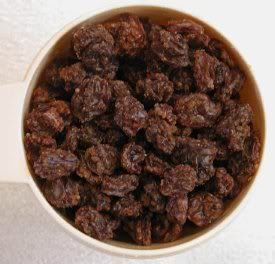
Raisin Circle - Key To Achdut
י"א בשבט תשס"ז
Raisin is one key fruit eaten and shared among both Celtic Imbolg (February 2) and Jewish Tu B'Shevat (February 3 this year) sacred days. The Hebrew word for raisin [1] is צימוק.
The shoresh (3 letter root) of raisin (צמק) means "shrinking", "drying" and "shriveling" [2]. The word raisin is found in Torah in 1 Shmuel (Samuel) 25:18 in the form צמוקים. This form, though seemingly plural, is translated as raisin, singular (yachid). Moreover, the form צמוקים follows the Masoretic tradition - the text used by R. Shmuel Raphael Hirsch, from whose commentaries the etymological source dictionary I use was compiled. In other words, צמוקים is the way the word appears according to the Aleppo Codex (כתר ארם צובה).
However, in most printed and online Hebrew texts of Torah, the word in 1 Shmuel 25:18 isn't spelled this way. It is spelled צמקים. Neither the letter yod (י) nor the letter vav (ו) as found in the normative word for raisin (צימוק) is found in commonly available Hebrew texts of Torah (the Bible).
There seems to be some confusion about whether raisin is singular or plural (where ים is a plural ending), and whether or not it is spelled with a yod and a vav added into the root. Normatively, raisin is spelled with a letter yod following the letter tzadi (צ), and then a letter vav following the letter mem in its open form (מ). However, in the Aleppo Codex, singular raisin is spelled with a plural form, and with a letter vav (as opposed to a letter qof ק) after the letter mem. There is no letter yod in the root in the Aleppo Codex concerning 1 Shmuel 25:18 - but there is a letter yod in the plural form preceding a closed letter mem (ים) in its final form in the Aleppo Codex.
What can all this quasi-confusion mean?
First, the root implies dry because there is no water (מים) in it. Raisin, as found in the Aleppo Codex changes the entire meaning of the root - because (written in the plural form), singular raisin indeed has water in it (צמוקים). The open mem pertains to wisdom of the revealed world, while the closed mem pertains to wisdom of the hidden world. Consequently, the masoretic form contains both kinds of wisdom - concealed and revealed. In the normative Hebrew form of raisin, hidden wisdom is not present.
The root letter yod (in distinction to the yod of the plural ending), missing in most (if not all) printed and online versions of Torah and Tanakh, is also not present in the Aleppo Codex. Yet, the letter is present in the mundane sense, in the normative spelling of the Hebrew word raisin. This means that we have to find this letter in our everyday material world of action. It's not somewhere "out there", far from us. It is close, very close to us. It is even within our own souls, each and every one of us. It's not in the exclusive domain of the learned and mystically pious. It's ours, every one! Yod, in the soul, represents the feminine power of the left hand. Thus, what brings revealed and hidden mysteries to unified expression is the feminine power of the left hand.
Taking all this together, we can see that sharing is key to uncovering, partaking of, and bringing to revelation, the hidden mysteries. It is for this reason that singular raisin is written in the plural form - written plural yet pronounced singularly - the essence of achdut (egregore) is perfect unity in the presence of multiplicity.
Footnotes:
[1] New Bantam-Megiddo Hebrew & English Dictionary
[2] Etymological Dictionary of Biblical Hebrew, R' Matutyahu Clark
Sunday, January 28, 2007
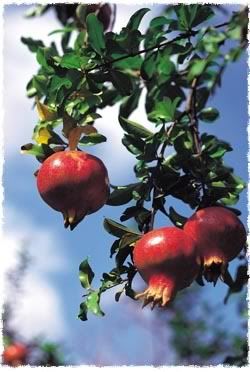
Pomegranate - Return To Holiness
ט' שבט ה'תשס"ז
The fifth product of the Land of the Divine Feminine eaten during Tu B'Shevat is the pomegranate (rimon, רימון). Thought to be the fruit of the Tree of Knowledge, rimon can mean either the pomegranate fruit or shell.
In Jewish kabbalah, a shell is a kelipah. A kelipah is "the outer shell which conceals the godly light within all creation; hence, it is the unholy side of the universe."
As the epitome of unholiness, the root from which rimon is derived is RMM (רמם), meaning "exalting", "raise from a low level", "elevating" and "bringing to life" [1]. Moreover, Ramchal [2] teaches in Secrets Of The Redemption:
At present the shell is in an impure state, but it is needed - its role is to protect the inside. However (in the era of redemption), then the shell itself will be on a holy level.
Thus, the pomegranate contains within its symbolism the holy seeds of "unholiness" and through the meaning of the root, elevates and transforms the impure to the pure. In other words, by eating of this fruit, we are raising the shell which is our material animal nature, elevating it to a holy nature, and bringing vitalized holiness into our life. We are returning our physical nature, not to innocence, but to experienced holiness.
Footnotes:
[1] Etymological Dictionary Of Biblical Hebrew, R' Matityahi Clark (p. 245)
[2] Rabbi Moshe Chaim Luzzatto, Secrets Of The Redemption (p. 102)
Saturday, January 27, 2007
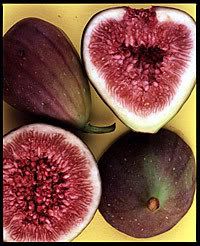
Fig - Cell Of A Song
ח' שבט ה'תשס"ז
The fourth product of the Land of the Divine Feminine eaten during Tu B'Shevat is the fig. Again, as with the last two "foodstuffs", the word (in Devarim 8:8) for fig (ותאנה) is prefaced with a connecting vav. The root is תאנ and the final letter hey (ה) is a feminine ending.
Significantly, the gate (2-letter root, sha'ar in Hebrew) to the shoresh (3 letter root) consists of the word "ta" (תא), a "completely dark" cell of the Holy Temple [1] corresponding to midat hadin (the attribute of justice) [2]. Normally, humankind cannot endure strict midat hadin. Yet, this attribute forms the foundation of each feminine cell of the Holy Temple.
Moreover, King Solomon recognized that the essence of the Divine Spirit is contained within the "order of justice" (midat hadin) [2] and prayed for it to be made understandable to man. Understanding (corresponding to the sefirah Binah), as is a Temple cell (corresponding to the sefirah Malchut), is a feminine quality. The feminine quality of Understanding corresponds to the letter nun (נ), the third letter in the shoresh following the gate "ta". Importantly, the letter nun symbolizes the messianic soul [1]. Thus, it is here, hidden in the symbolism of the fig, where a woman may access her messianic soul spark.
Like King Solomon, the ancient Celts recognized the Presence of the Divine Spirit in the complete darkness of a cell.
In Ireland, Wales and Scotland, bardic colleges would use a technique for incubating tehilim (psalms, songs of prophetic poetry) called the cell of a song. A bard-psalmist would be laid on a wattle bed in a closed, windowless cell ...after 24 hours, the bard would emerge from the darkness and write of that revealed there.
Ancient Celtic bards, like ancient Hebrew psalmists and Welsh awenyddion, were prophetic poets whose prophecies were oftentimes accompanied by song or music.
Taking all this together, we can understand that the fourth product of the Land we eat during Tu B'Shevat symbolizes the experience of the complete darkness found in the cell of the Holy Temple. Evidence that we have truly "eaten" of it, and thus internalized its message, is the poetry and artistry that such an experience itself produces in the one who has experienced it.
The musical poetry of Walking On Fire.
Bringing light from darkness and cells of the Temple.
Footnotes:
[1] The Hebrew Letters, R' Yitzchak Ginsburgh (p. 325 and p. 216)
[2] Wisdom In The Hebrew Alphabet, R' Michael Munk (p. 229)
Thursday, January 25, 2007
V'Gefen - A Winding, Intertwining Path
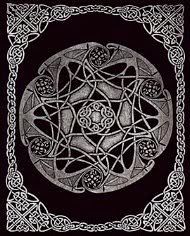
Celtic tapestry with a Jewish magen David in its design.
ז' שבט ה'תשס"ז
The third product of the Land we eat during Tu B'Shevat is v'gefen (וגפן). As discussed in my previous entry, the first letter vav is connective. V'gefen is typically translated as grape, and grapes are indeed the "product of the land" on most Tu B'Shevat seder plates. However, the word in Devarim 8:8 is not grape. In Hebrew, the word for grape is enav (ענב).
The root of v'gefen is גפף meaning "winding", "curving", "twisting", "intertwining vine", "raised edges" and "body/limb". The word gefen גפן can mean vine. Grapes are fruits of the vine. Nevertheless, Torah didn't say "grape", it used the root implying something that is winding, twisting and intertwining. Why?
The first product we internalize (eat) of the Land, is the kavanah (mystical intention) to reconnect each and collectively to our Divine soul. This was characterized by the wheat. The second product we internalize is the realization of reconnection, characterized by the barley. With gefen, the third product of the Land, we begin a long and winding journey toward self-discovery, while at the same time, we are intertwining our natural nature with our Divine nature.
Thus, we can see that the fruits we eat during Tu B'Shevat contain within them a mystical message for us. That message is a recipe for reunifying our natural nature and our godly nature, and for drawing the power of that reunification out into our living reality.
The Subterranean Temple - on the long and winding nature of the path to the hidden ark.
Barley - Evidence Of Reconnection
ז' שבט ה'תשס"ז
Note that today's Hebrew date rests like a double shabbat, a shabbat shabbaton, and like the double edges of a witch's athame, between two letters zayin (ז ... ז).
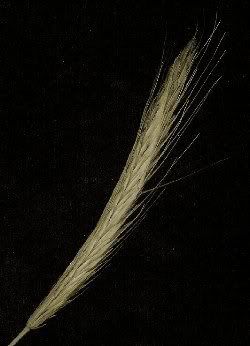
The second product of the Land that we traditionally eat during Tu B'Shevat is barley. The word in Devarim 8:8 is ושׂערה meaning "and barley", where the first [1] letter is a vav (ו) of connection called a vav hachibur. This is the vav which reconnects the letter yod to the letter chet in the word wheat (חיטה) as discussed in my previous entry, Wheat - From Galut To Geulah (from exile to redemption).
Evidence for this reconnection is found in the root שׂער of the word for barley, which implies a strong movement from within [2]. The first letter of the root is sin ("s" sound) as opposed to shin ("sh" sound), with a nikud (dot) over the left pillar as opposed to the right pillar. Consequently, we can see that the movement manifests through action of the feminine left emanation.
What is this movement? It is the movement described in Sefer Yetzirah 1:6 and 6:1 as a stormwind, the se'arah. Ruach se'arah [3] is a klipah (as I've distinguished previously here, Sufah and Se'arah), in contradistinction to ruach hakodesh or divine inspiration. Like its ezer knegdo, the shoresh "against it" (שרע), it implies stretching and extending in response to a strong inner movement. In other words, it is deliberate, measured, active work. This klipah gives the soul something to push and pull against enabling growth. As a yetziratic "agitating wind" meant to loosen distorted complexes in the soul for removal and/or reconstruction, ruach se'arah is neither as powerful nor as potentially destructive as Ruach HaShem. Ruach se'arah results when the human moves toward the divine. Ruach HaShem results when the divine bestows upon the human. Consequently, the powerful presence of the "chaotic dynamic" described here is evidence that the reconnection has been established.
In my own life, this dynamic is discussed most notably here (Soul Of A Bat Kohen) and here (Modah Ani).
Footnotes:
[1] Hebrew is read right to left, as opposed to from left to right as with English.
[2] Etymological Dictionary Of Biblical Hebrew, R' Matityahu Clark
[3] Inner Space, R' Aryeh Kaplan
Wheat - From Galut To Geulah
ו' שבט ה'תשס"ז
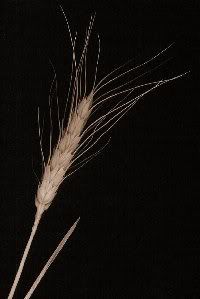
One of the traditional foods we eat on Tu B'Shevat is wheat (חיטה). However, in Devarim 8:8, the pasuk from which the tradition is derived, the word is not חיטה, it is חטה. In it's native state, the root חטה implies being "removed from the source of life", "sinning extensively" and "deviating from the path" [1].
Nevertheless, most chumashim translate the word חטה, as it in its native state, as wheat. What can we learn from this?
First, the reason the root implies being removed from the source of life, is because the root חטה lacks the letter yod (י) which the word wheat contains. With the letter yod included, the entire meaning of the root is transformed. The yod becomes reconnected to the source of life. In other words, from the perspective of the pintele yid (the aspect of the soul hardwired into the Divine and represented by the yod), it is disconnected from life (represented by the letter chet ח) in the root חטה.
When the yod and the chet are reunited in the word wheat, we form the word chai חי (representing both the chayah and yechidah soul levels and life). Moreover, kabbalistically, חי represents one's messianic soul.
The remaining letters of the word חיטה are tet (ט) and hey (ה), each representing the feminine yesod and malchut (aretz), respectively. Tet (a feminine vessel letter) functions to receive messianic awareness, while hey (a feminine letter of expressive bestowal) functions to express and distribute it.
Thus, by pronouncing חטה as חיטה we are infusing our "native state of awareness" (katnut consciousness) with the kavanah to drive us toward a "messianic state of awareness" (gadlut consciousness). We are making it a reality by pronouncing it the way we want reality to be, by recognizing that at some level, it already is.
This year, Monday January 29, is a Jewish observance called Yod Shevat (the tenth of Shevat). It is, before we celebrate either Imbolg or Tu B'Shevat.
Footnote:
[1] Etymological Dictionary Of Biblical Hebrew, R' Matityahu Clark
Wednesday, January 24, 2007
Tu B'Shevat - Fruit From The Land
 ו' שבט ה'תשס"ז
The very next day following Imbolg, celebrating She Who Heals, on February 3 this year, is the Jewish celebration of Tu B'Shevat, celebrating the New Year for Trees. It is customary on Tu B'Shevat to eat "native fruits" of The Land. Called Eretz Yisrael in Torah, "the land" here refers to the Land of the Divine Feminine.
It is quite appropriate then to connect these two sacred days - Imbolg and Tu B'Shevat. First, during Imbolg, She heals the land. Then, during Tu B'Shevat, He eats of Her fruits.
The time will come when the feminine will have greater access to transcendental consciousness than the masculine; and in that time, she will bestow and man will receive from her. R. Schneur Zalman of Liadi, Tefilat LaKhal HaShana
Tuesday, December 19, 2006
Instruments Of Divine Experience
Chatzot Of The Year, 29 Kislev 5767
Erev Rosh Chodesh Tevet, 5th Chanukah candle
new moon in Sagittarius Wednesday morning, 8:01 a.m. U.S. CST
According to Sefer Yetzirah, Wednesday is ruled by the planet Venus. The Hebrew and Celtic archetypes corresponding to Venus are Moshe and Rhiannon, respectively.
Moshe is an archetype of messianic consciousness whose name means "drawing out". In Celtic mysticism, Rhiannon is an archetype of the "great mother" whose name means "great queen".
Transliterated phonetically into Hebrew letters, Rhiannon רי ענן suggests the concepts of "clarifying and consciously experiencing" (ר) the concentration of something "infinite within the finite" (י) of a cloud (ענן), where the cloud represents the manifestion of the yud (י) of Hashem's Name. Taken together with the name of Moshe, the two archetypes (masculine and feminine side by side) correspond to the ability to clarify, experience (Rhiannon) and draw out (Moshe) the concentration of something "infinite within the finite" to reveal that concealed within a cloud (of consciousness). In other words, together Rhiannon and Moshe are instruments enabling revelation and experience of the Divine Glory.
What is the function of "the cloud" contained within the name of Rhiannon?
Rabbi Efrayim of Lunshitz, author of the Kli Yakar commentary, explains:
Erev Rosh Chodesh Tevet, 5th Chanukah candle
new moon in Sagittarius Wednesday morning, 8:01 a.m. U.S. CST
According to Sefer Yetzirah, Wednesday is ruled by the planet Venus. The Hebrew and Celtic archetypes corresponding to Venus are Moshe and Rhiannon, respectively.
Moshe is an archetype of messianic consciousness whose name means "drawing out". In Celtic mysticism, Rhiannon is an archetype of the "great mother" whose name means "great queen".
Transliterated phonetically into Hebrew letters, Rhiannon רי ענן suggests the concepts of "clarifying and consciously experiencing" (ר) the concentration of something "infinite within the finite" (י) of a cloud (ענן), where the cloud represents the manifestion of the yud (י) of Hashem's Name. Taken together with the name of Moshe, the two archetypes (masculine and feminine side by side) correspond to the ability to clarify, experience (Rhiannon) and draw out (Moshe) the concentration of something "infinite within the finite" to reveal that concealed within a cloud (of consciousness). In other words, together Rhiannon and Moshe are instruments enabling revelation and experience of the Divine Glory.
What is the function of "the cloud" contained within the name of Rhiannon?
Rabbi Efrayim of Lunshitz, author of the Kli Yakar commentary, explains:
"The cloud covered the Tent of Appointment, and the Glory of God filled the cloud" (Shemot 40:34) - from this it appears that the Glory of God is not the cloud, but rather the fire and the light, i.e. the Glory of God was seen from within the cloud; were it not for the cloud, it would have been impossible to gaze upon it, for man cannot gaze into the light of the sun, kal va-chomer he cannot look at the brilliance of His Presence. Therefore the holy light was always seen from within the cloud ...
Subscribe to:
Posts (Atom)