Showing posts with label temple. Show all posts

Wednesday, August 11, 2010

Genuine ABRAMELIN ANOINTING OIL

ב' באלול תש"ע
Belz 4

From the sacred text of Torah, this ancient recipe genuine ABRAMELIN ANOINTING OIL is made with certified organic, earth kosher botanicals, including (Cinnamomum zeylanicum) Sweet Cinnamon from Madagascar, Cinnamon Bark (Cinnamomum zeylanicum) Essential Oil from Sri Lanka, premium Myrrh Resin, Calamus Root (Acorus calamus), Cassia (Cinnamomum cassia) and wildharvested extra virgin Olive Oil.


"Take thou also unto thee the chief spices, of flowing myrrh five hundred shekels, and of sweet cinnamon half so much, even two hundred and fifty, and of sweet calamus two hundred and fifty, and of cassia five hundred, after the shekel of the sanctuary, and of olive oil a hin." [Exodus 30:23-24]

Sweet Cinnamom [וְקִנְּמָן-בֶּשֶׂם] comes from the magical Hebrew root קנן and pertains to protective shelter, a refuge "there" [בשם].

Cassia [וְקִדָּה] comes from the magical Hebrew root קדד and pertains to a crown of the head.

Myrrh [מָר-דְּרוֹר] comes the magical Hebrew roots מרא and pertains to "wings expanding in flight" and דרר meaning "precious stone" and "returning to one's origin or source."

Calamus [וּקְנֵה-בֹשֶׂם] comes from the magical Hebrew root קנה and pertains to "acquisition by legal and just means" a "protective sheltering nest there" [בֹשֶׂם].

Olive oil [וְשֶׁמֶן זַיִת] comes from the magical Hebrew roots: שמן which means to be healthy, be nourished and have abundance - and זית which means to flow out into manifestation speedily.

This special blend of genuine ABRAMELIN ANOINTING OIL comes in a 4 dram amber glass vial with a black screw cap. The vial is adorned with a copper Star of David charm hung with handmade Mysterious Silk Sari ribbon and black satiny ribbon.

Handcrafted under the waxing crescent Moon 5% full during the planetary hour of Jupiter (ת).

Comes beautifully packaged.

This magical oil may be purchased at WITCHCRAFTS by Liorah Lleucu.

Friday, May 16, 2008

מכתם לדת - Michtam L'Dat

י'ב באייר תשס"ח
Mab 13

מכתם לדת

I ritually stained the wood of my carved staff this evening with a red-ochre pigmented blend of botanicals, under the waxing gibbous moon 92% full, beginning during the planetary hour of Jupiter (ת) and finishing for the night during the planetary hour of the Sun (ד), drawing out from among twenty feda the ogham letter Saille (aravah) whose keyword is flow and whose corresponding mystical concepts [1] include:

female moon times
connecting with the Ancestors
knowledge of proper timing, tides of time

Additional associations [2, 3]:

liminal zones
witchcraft, magic and the feminine mysteries
divination, seership and prophecy
psychic perception and intuitive sensitivity
interweaving the revealed (itkafia) and the hidden (ithapcha)
water and mystic eloquence

lips
sukkot, joy
hoshanah rabbah
the temple in Yerushalayim


Footnotes:

[1] Ogam: Weaving Word Wisdom by Erynn Rowan Laurie


[2] Ogam: The Celtic Oracle Of The Trees by Paul Rhys Mountfort

[3] Inner Dimension, ערבה

Saturday, January 27, 2007

Fig - Cell Of A Song


ח' שבט ה'תשס"ז

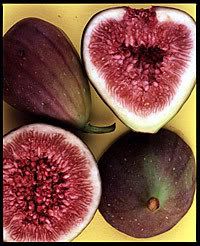
The fourth product of the Land of the Divine Feminine eaten during Tu B'Shevat is the fig. Again, as with the last two "foodstuffs", the word (in Devarim 8:8) for fig (ותאנה) is prefaced with a connecting vav. The root is תאנ and the final letter hey (ה) is a feminine ending.

Significantly, the gate (2-letter root, sha'ar in Hebrew) to the shoresh (3 letter root) consists of the word "ta" (תא), a "completely dark" cell of the Holy Temple [1] corresponding to midat hadin (the attribute of justice) [2]. Normally, humankind cannot endure strict midat hadin. Yet, this attribute forms the foundation of each feminine cell of the Holy Temple.

Moreover, King Solomon recognized that the essence of the Divine Spirit is contained within the "order of justice" (midat hadin) [2] and prayed for it to be made understandable to man. Understanding (corresponding to the sefirah Binah), as is a Temple cell (corresponding to the sefirah Malchut), is a feminine quality. The feminine quality of Understanding corresponds to the letter nun (נ), the third letter in the shoresh following the gate "ta". Importantly, the letter nun symbolizes the messianic soul [1]. Thus, it is here, hidden in the symbolism of the fig, where a woman may access her messianic soul spark.

Like King Solomon, the ancient Celts recognized the Presence of the Divine Spirit in the complete darkness of a cell.
In Ireland, Wales and Scotland, bardic colleges would use a technique for incubating tehilim (psalms, songs of prophetic poetry) called the cell of a song. A bard-psalmist would be laid on a wattle bed in a closed, windowless cell ...after 24 hours, the bard would emerge from the darkness and write of that revealed there.

Ancient Celtic bards, like ancient Hebrew psalmists and Welsh awenyddion, were prophetic poets whose prophecies were oftentimes accompanied by song or music.

Taking all this together, we can understand that the fourth product of the Land we eat during Tu B'Shevat symbolizes the experience of the complete darkness found in the cell of the Holy Temple. Evidence that we have truly "eaten" of it, and thus internalized its message, is the poetry and artistry that such an experience itself produces in the one who has experienced it.

The musical poetry of Walking On Fire.

Bringing light from darkness and cells of the Temple.

Footnotes:

[1] The Hebrew Letters, R' Yitzchak Ginsburgh (p. 325 and p. 216)

[2] Wisdom In The Hebrew Alphabet, R' Michael Munk (p. 229)

Thursday, January 25, 2007

V'Gefen - A Winding, Intertwining Path


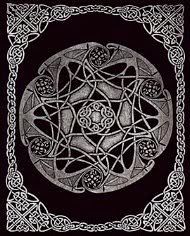
Celtic tapestry with a Jewish magen David in its design.

ז' שבט ה'תשס"ז

The third product of the Land we eat during Tu B'Shevat is v'gefen (וגפן). As discussed in my previous entry, the first letter vav is connective. V'gefen is typically translated as grape, and grapes are indeed the "product of the land" on most Tu B'Shevat seder plates. However, the word in Devarim 8:8 is not grape. In Hebrew, the word for grape is enav (ענב).

The root of v'gefen is גפף meaning "winding", "curving", "twisting", "intertwining vine", "raised edges" and "body/limb". The word gefen גפן can mean vine. Grapes are fruits of the vine. Nevertheless, Torah didn't say "grape", it used the root implying something that is winding, twisting and intertwining. Why?

The first product we internalize (eat) of the Land, is the kavanah (mystical intention) to reconnect each and collectively to our Divine soul. This was characterized by the wheat. The second product we internalize is the realization of reconnection, characterized by the barley. With gefen, the third product of the Land, we begin a long and winding journey toward self-discovery, while at the same time, we are intertwining our natural nature with our Divine nature.

Thus, we can see that the fruits we eat during Tu B'Shevat contain within them a mystical message for us. That message is a recipe for reunifying our natural nature and our godly nature, and for drawing the power of that reunification out into our living reality.

The Subterranean Temple - on the long and winding nature of the path to the hidden ark.

Wednesday, January 24, 2007

Nataf - A Blend From Within

ה' שבט ה'תשס"ז

Three substances in Torah allude to the entire 11-component blend of the Temple incense. They are nataf (storax, commonly known as benzoin), shechelet (onycha) and chelbenah (galbanum). Significantly, each one has a unique feature - making the Temple incense a blend of uniqueness, like my 3-name blend is unique to me. Nataf (נטף) flows from within [1]. Shechelet (שחלת) grows from the earth (malchut). Chelbenah (חלבנה) is seemingly evil (reflected in the 11 original components of tohu [2]), but in truth, is holy (reflected in the 16 rectified and elevated components of b'yad ramah).

Footnotes:

[1] Etymological Dictionary Of Biblical Hebrew, R' Matityahu Clark

[2] Inner Space, R' Aryeh Kaplan (p. 86)

Tuesday, January 16, 2007

Mishkan, Circle Of Protection

Ashnistrike commented regarding my entry Athame & Mezuzah (also posted on my blogs), writing:

I'll just say that as someone who uses both an athame and a mezuzah, I'm interested in the possible connections that can be drawn between them. Do you integrate this connection into any of your practices?

In practice, I only use the athame presently. My mezuzot are stored away in a chest. When I became a ba'alat teshuvah over a decade ago, my professional livelihood was deliberately destroyed. I've stayed with relatives for the past several years. I can't put up a mezuzah.

Of course, I'm sure my enemies are quite pleased with the fact that I can't put up a mezuzah. Nevertheless, I don't need it. It's like all the other rituals tools - the only real tool a witch needs is herself. I truly know this now.

A few days ago I had a vision of a metaphysical fist being flung toward me, and of it being deflected by an invisible shield around me. I was only able to "see" the shielding force by the "reverberations" in spacetime and shapeshifting coming off the dark light (which the shield was made of) as the striking fist impacted against the field which surrounded me. I never take my circle down. It goes with me wherever I go.

And every shabbat and with every ritual, I reinforce it.

Tuesday, January 09, 2007

Athame Of Iron On The Altar Of The Temple


The iron blade of a witch's athame upon her altar is a perfect symbol for the rectification of evil and its elevation back into the realm of kedushah (holiness, sacredness). In the Jewish tradition, this rectification and re-elevation is called tikun olam (repair of the world).

The iron of knives and swords have historically been used to shorten life, making them typically antithetical for use upon a sacred altar, whose purpose is to enhance and lengthen life. However, in the "future world" (in Hebrew "leatid lavo" לעתיד לבא, a code for the transcendent rectified feminine sefirah Binah and her parzufim), our Sages teach that the Temple will be built using iron. Normally, it is forbidden to use tools of iron to cut stones for the Temple altar.

Kabbalistically, iron, one of the seven metals [1] corresponding to the seven mystical attributes of the heart, corresponds to the attribute of Malchut and the element of the heart most "vulnerable to negativity and egocentricity". Malchut symbolizes the feminine Kingdom of the world of action and expression (see sefirotic array here). It also symbolizes the Indwelling Divine Feminine, the Shechinah. In the supernal world of Atzilut, in Judaism, Malchut is called Eretz Yisrael (the Land of Israel). Other spiritual traditions have other names for it, but the message is similar - it represents the Land of the Divine Feminine.

Consequently, we can see that Jewish tradition teaches that iron found in the Land of the Divine Feminine is completely holy and invulnerable to the negativity normally associated with iron. This makes the iron blade of a witch's athame a perfect symbol for the completely holy Divine Feminine.

Footnote:

[1] Seven metal correspondences according to the Zohar, Shemot, Va'Era (hat-tip to Jack Nathanson):

silver - chesed (lovingkindness)
gold - gevurah (strength)
copper - tiferet (compassion)
lead - netzach (endurance)
iron pyrite - hod (empathy)
tin - yesod (foundation)
iron - malchut (kingdom)

Wednesday, November 01, 2006

Celebrating The Sacred Feminine

Samhain, the holy day of the Ancestors, is observed from sundown October 31 through November 1. Samhain honors the dark Divine Feminine, the "dark half" of the year, marks the onset of winter, and is the Celtic New Year.

As a time when one cycle ends and a new one begins, Celtic tradition teaches that the veil separating the manifest world from the supernal realms is particularly thin and open during Samhain. In consequence to the "break" in the flow of time, Samhain is an opportunity for profound mystical transformation. Like Lag B'Omer, mystical bonfires have a role in the observance of Samhain.

The word Samhain derives from the Proto-Celtic word samani, which means "assembly" (cognate to Sanskrit sámana). [1] The Hebrew equivalent to Samhain is the word כינוס from the root כנס meaning "assembling", "gathering" and "bringing together". This root is found in Tehilim 147:2 ...

"The L-rd rebuilds Jerusalem; She gathers in the exiles of Israel."

:בונה ירושלם יהוה; נדחי ישראל יכנס

The first word in this pasuk is "boneh" בונה from the same root as Binah, a feminine sefirah of the "dark" left emanantion. Literally, the first part of this pasuk reads like a command "build Jerusalem Hashem!" The Divine She is She who commands it be done.

Thus, the secret of Samhain, a holy day of proto-Celtic origin, is mystically connected to the commands to rebuild Jerusalem and to ingather the exiles. Moreover, these commands are directly related to the "dark" Divine Feminine principle, which indeed, Samhain celebrates.

Also, given the bonfire connection to both Lag B'Omer and Samhain, and where Lag B'Omer is called the "Scholars' Festival" (pertaining to men), I hereby dedicate Samhain to be the "Scholars' Festival" (pertaining to women).

Footnote:

[1] W. Stokes in KZ 40:245 (1907), see here